Changelog
Version 2.6 (2026)
Declarative Grid Search: Added
GridSearch[T]type hint andgenerate_grid()for resolving parameter sweeps, supporting inline lists, step-based value ranges, and geometric progression sweeps (range_mult).Web UI overhaul: feature parity with the TUI, plus a task dependency graph, a scheduler log viewer, a tabbed job details/logs modal, a connection-status indicator, and a new application logo.
Pydantic-based configuration: settings moved from OmegaConf to Pydantic, with parameter provenance and
${env:...}interpolation insettings.yaml.Frontend builds are minified by default; set
XPM_NO_WEBUIto skip them.Fixes for carbon tracking (codecarbon daemon thread, offline tracker) and job execution (zombie reaping, lock release).
Version 2.5 (2026)
New
Prepareconfig for in-memory data preparation, and a newxpmconfigattribute.Job directories are kept by default (
keep = True) and--run-modeis case-insensitive.Fixes around local-task signal handling, dry-run isolation, multi-run event routing, and service log directories.
Version 2.4 (2026)
Workspace folders (beta) (#55): archive jobs to auxiliary workspace folders.
New
experimaestro experiments copycommand for cross-workspace transfer.Deleted jobs are marked with a
DELETEDstatus (#210);params.jsonpaths are encoded relative to the job or workspace (#228).Improved SSH monitoring (
kill_job, process info,--request-timeout) and several TUI and Windows compatibility fixes.
Version 2.3.0 (2026)
New Features
Experiment Actions (alpha)
Actions are user-defined operations that can be registered during task submission and executed after experiment completion. They support interactive user input via CLI (rich prompts) and TUI (modal dialogs).
from experimaestro import Task, Action, Interaction, Param

class ExportToHub(Action):
    model: Param[Model]

    def describe(self) -> str:
        return "Export model to HF Hub"

    def execute(self, interaction: Interaction) -> None:
        name = interaction.text("name", "Hub model name:")
        self.model.push_to_hub(name)

class TrainModel(Task):
    model: Param[Model]

    def __submit__(self, dep, add_action, **kwargs):
        add_action(ExportToHub.C(model=self.model))
        return self
Run actions via CLI or TUI:
experimaestro experiments actions list
experimaestro experiments actions run
Streaming config serialization (objects.jsonl)
Job configs and actions are now streamed to objects.jsonl as they are submitted,
replacing the old configs.json batch serialization at experiment finalization.
Use load_xp_info() to load experiment data:
from experimaestro import load_xp_info

info = load_xp_info("/path/to/run_dir")
info.jobs     # dict[str, Config]
info.actions  # dict[str, Action]
__submit__ method
The new __submit__(self, dep, add_action, **kwargs) method on tasks replaces
task_outputs. It receives an add_action callable for registering actions.
Legacy task_outputs methods continue to work.
Bug Fixes
Fixed race condition where
on_completedcallbacks could run after experiment exit. Exit notifications are now routed through the notification executor to ensure all callbacks complete beforewait()returns.
Deprecations
load_configs()is deprecated in favor ofload_xp_info().configs.jsonis replaced byobjects.jsonl(old format still loadable for backward compatibility).
Version 2.0 (2025)
Version 2.0 is a major release with significant new features, improved developer experience, and important breaking changes.
New Features
Terminal UI (TUI)
A new interactive terminal interface built with Textual for monitoring experiments:
Real-time experiment and job monitoring
Push notifications via file watching
SQLite persistence for tracking multiple experiments
Orphan job detection and cleanup
Clipboard support via OSC 52 (works over SSH/tmux)
Thread-safe updates
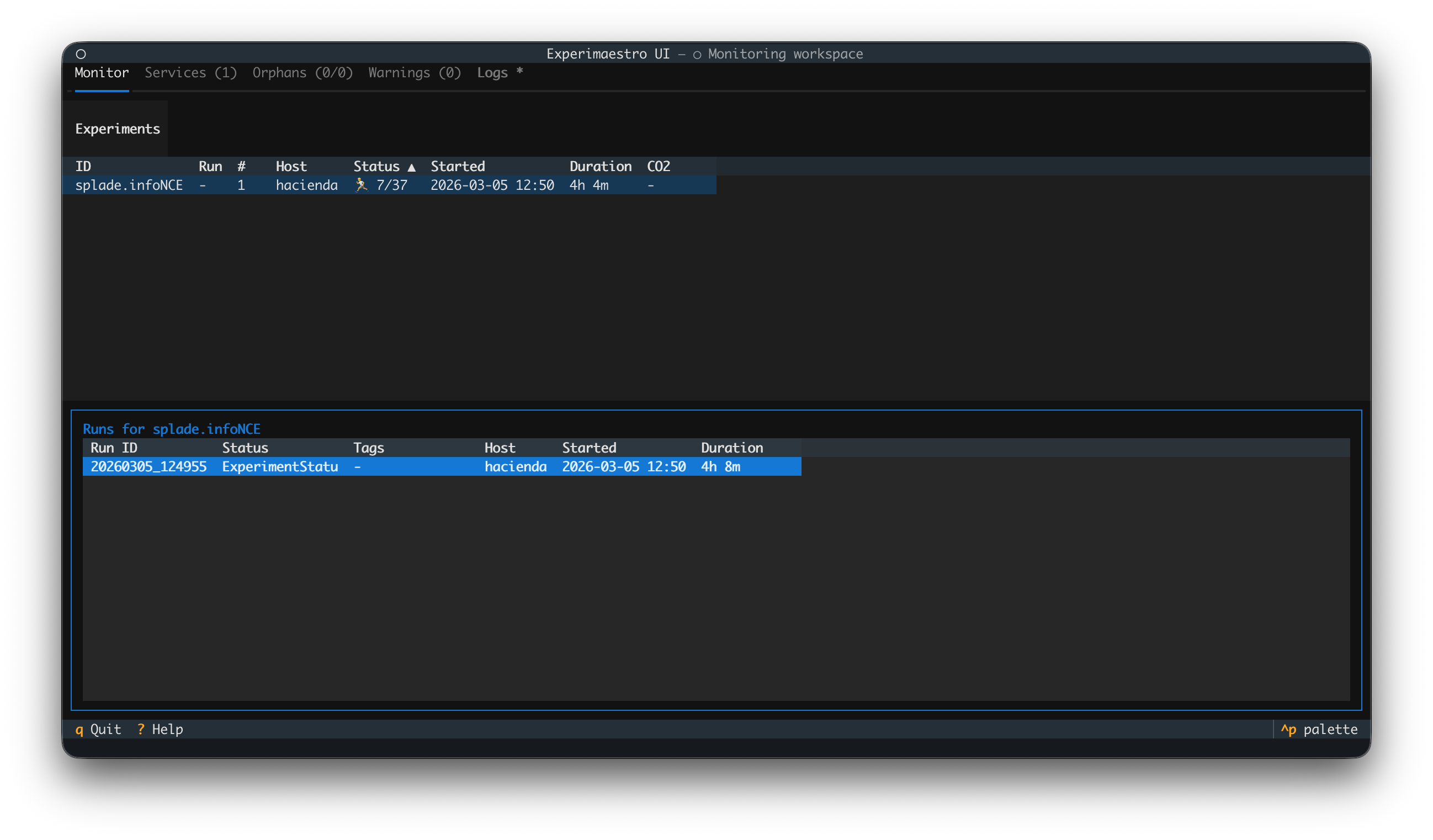
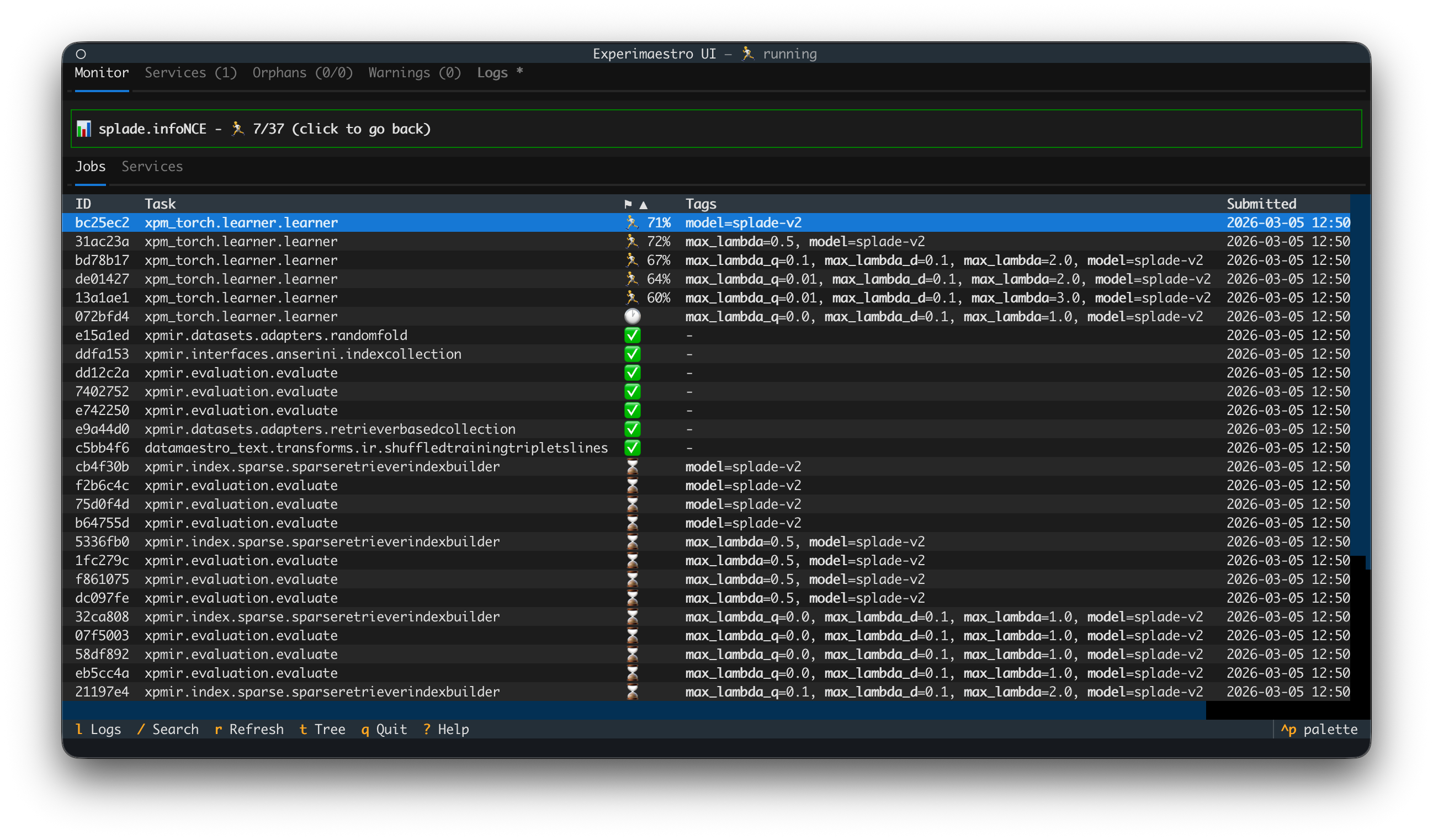
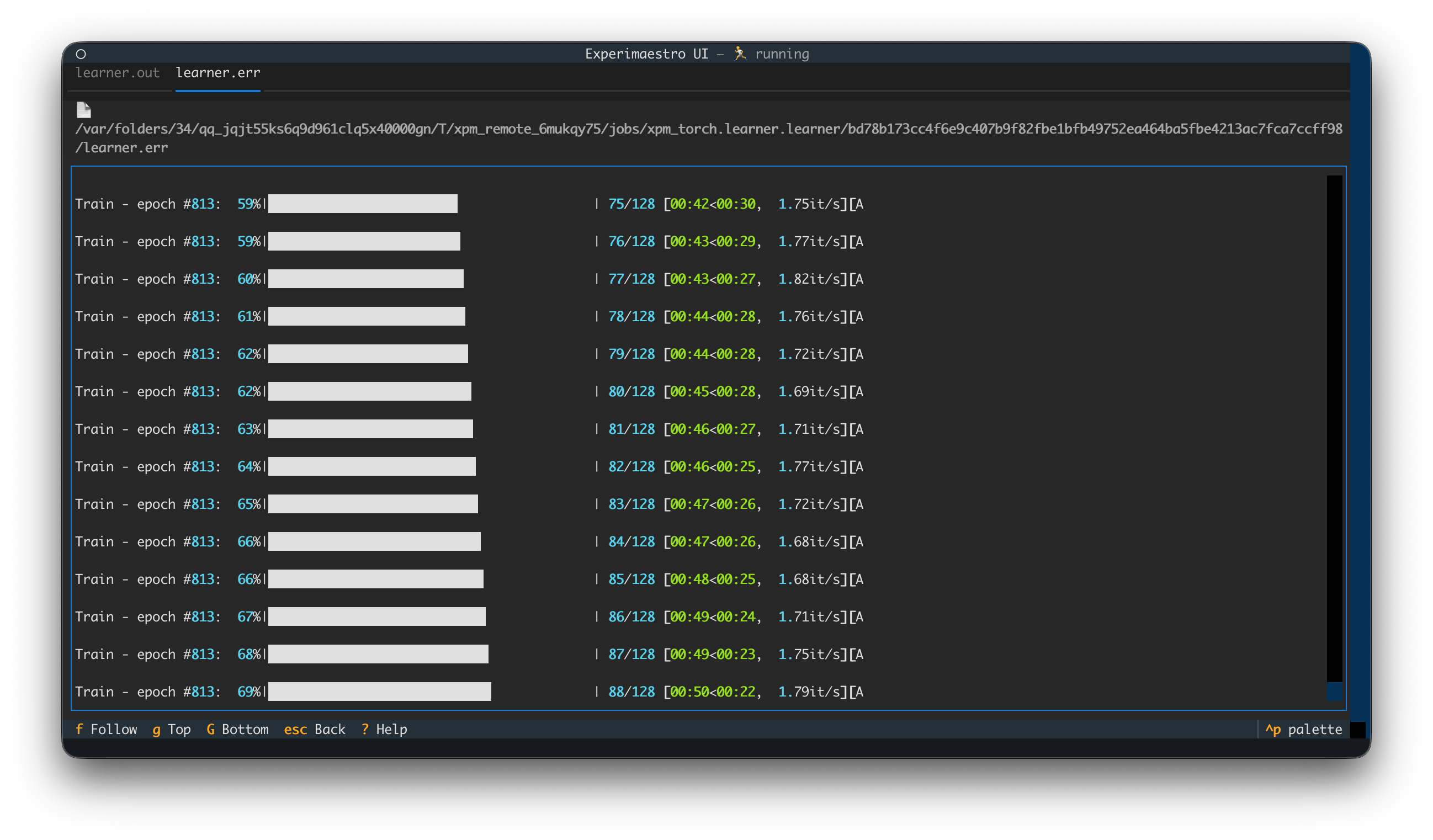
Launch with:
experimaestro experiments --workdir /path/to/workdir monitor --console
with workdir one of the directories defined in the Settings
Resumable Tasks
Tasks can now handle timeouts gracefully and resume from where they left off:
from experimaestro import ResumableTask, GracefulTimeout, Meta, PathGenerator, field

class LongTraining(ResumableTask):
    epochs: Param[int] = 1000
    checkpoint: Meta[Path] = field(default_factory=PathGenerator("checkpoint.pth"))

    def execute(self):
        start_epoch = load_checkpoint(self.checkpoint) if self.checkpoint.exists() else 0

        for epoch in range(start_epoch, self.epochs):
            remaining = self.remaining_time()  # Query remaining walltime (SLURM)
            if remaining is not None and remaining < 300:
                save_checkpoint(self.checkpoint, epoch)
                raise GracefulTimeout("Not enough time for another epoch")

            train_one_epoch()
            save_checkpoint(self.checkpoint, epoch)
remaining_time()method to query remaining walltimeGracefulTimeoutexception for clean timeout handlingConfigurable
max_retries(default: 3) for automatic retry on timeoutLog file rotation when resuming tasks
Graceful termination: Handle SIGTERM/SIGINT with
TaskCancelledfor custom cleanup
Dynamic Task Outputs
Tasks can now produce outputs during execution with callback support, useful for triggering evaluation on intermediate checkpoints while training is still running:
from experimaestro import ResumableTask, Config, Param, DependentMarker

class Validation(Config):
    model: Param[Model]

    def checkpoint(self, dep: DependentMarker, *, step: int) -> Checkpoint:
        # dep() marks the output as depending on the producing task,
        # so different learning rates produce different checkpoint identifiers
        return dep(Checkpoint.C(model=self.model, step=step))

    def compute(self, step: int):
        self.register_task_output(self.checkpoint, step=step)

class Learn(ResumableTask):
    validation: Param[Validation]

    def execute(self):
        for step in range(100):
            train_step()
            if step % 10 == 0:
                self.validation.compute(step)  # Signals output, triggers callbacks

# Register a callback and submit
def on_checkpoint(checkpoint: Checkpoint):
    Evaluate.C(checkpoint=checkpoint).submit()

learn = Learn.C(model=model, validation=validation)
learn.watch_output(validation.checkpoint, on_checkpoint)
learn.submit()
Only available on
ResumableTaskCallbacks are replayed when tasks restart, ensuring no outputs are missed
Multiple callbacks can watch the same output method
Callbacks run in a dedicated worker thread
Mypy Plugin
Full mypy support for experimaestro’s Config.C pattern:
# pyproject.toml
[tool.mypy]
plugins = ["experimaestro.mypy"]
Provides:
Type inference for
Config.C,XPMConfig,XPMValueProper
__init__signatures withParamandMetafieldssubmit()return type inference (includingtask_outputs)ConfigMixinmethods available on all Config subclasses
Partial Identifiers
Share directories across tasks that differ only in excluded parameters. This is particularly useful for:
Checkpoint sharing: Training runs with different iteration counts can share the same checkpoint directory, enabling seamless resume from any previous run
Resource efficiency: Avoid duplicating large files (model weights, preprocessed data) across similar experiments
Hyperparameter sweeps: When varying certain parameters (e.g., number of epochs), other outputs remain shared
Configuration Composition
Compose configurations using the @ operator. The operator automatically finds the parameter in the outer configuration that accepts the inner configuration’s type:
class Encoder(Config):
    hidden_size: Param[int]

class Model(Config):
    encoder: Param[Encoder]

# These two are equivalent:
model1 = Model.C(encoder=Encoder.C(hidden_size=256))
model2 = Model.C() @ Encoder.C(hidden_size=256)
Flexible Deprecation
Deprecate and redirect configurations with automatic migration:
@deprecate(NewConfig, replace=True)
class OldConfig(Config):
    ...
Instance-Based Identity
Distinguish between shared and separate instances with identical parameters using InstanceConfig. Essential for workflows where components can be tied or independent:
class Encoder(InstanceConfig):
    hidden_size: Param[int]

class DualEncoderModel(Config):
    query_encoder: Param[Encoder]
    doc_encoder: Param[Encoder]

enc = Encoder.C(hidden_size=128)
shared = DualEncoderModel.C(query_encoder=enc, doc_encoder=enc)      # tied weights
separate = DualEncoderModel.C(query_encoder=enc, doc_encoder=Encoder.C(hidden_size=128))  # independent
# shared and separate have different identifiers
Backwards-compatible: first instance keeps its original identifier.
Workspace Auto-Selection
Workspaces can be automatically selected based on experiment ID patterns:
# ~/.config/experimaestro/settings.yaml
workspaces:
  - id: neuralir
    path: ~/experiments/xpmir
    triggers:
      - "neuralir-*"
      - "ir-experiment"
Carbon Tracking
Track the environmental impact of your experiments with optional carbon emissions monitoring:
# Enable in ~/.config/experimaestro/settings.yaml
carbon:
  enabled: true
  country_iso_code: FRA  # Optional: override detected country
When enabled, experimaestro tracks CO2 emissions, energy consumption, and power usage for each job using CodeCarbon. Metrics are stored per-job and can be aggregated across experiments.
SSH Remote Monitoring
Monitor experiments running on remote servers directly from your local machine:
experimaestro experiments ssh-monitor user@cluster /path/to/workspace
Features include JSON-RPC communication over SSH, on-demand file synchronization for logs, and support for both Web UI and TUI. See Remote Monitoring via SSH for details.
Transient Tasks
Tasks that don’t need persistent storage can be marked as transient at submission time:
from experimaestro import TransientMode

# Skip if no dependent tasks need it
task.submit(transient=TransientMode.TRANSIENT)

# Run but remove directory after dependents complete
task.submit(transient=TransientMode.REMOVE)
Transient tasks are only executed if they have non-transient dependents, saving resources for intermediate computations.
Experiment Run History
Track multiple runs of the same experiment with automatic run numbering:
New layout:
experiments/{experiment-id}/{run-id}/View run history with
dkey in TUIEach run maintains its own jobs and state
Improved Stability
The scheduler has been refactored to use asyncio instead of threads for job management, resulting in more predictable behavior and reduced race conditions.
Other Features
Environment tracking: Git state and environment info saved for reproducibility
Conflict warnings: Warns on conflicting tag values with source location tracking
Override warnings: Warns when overriding arguments without
overrides=Trueflagvalue_classdecorator: Register external types as experimaestro valuesExplicit default behavior:
field(ignore_default=...)andfield(default=...)DynamicLauncher: Select launchers dynamically based on priority
AcceleratorSpecification: Cross-platform GPU support (CUDA, MPS, generic)
Protocol version checking: Client-server compatibility for remote monitoring
Colored logging: ISO timestamps and colored output for CLI (
--loggingoption)Events viewer: Stream experiment events to console (
--events-vieweroption)Workspace version checking: Prevents running v2 code against v1 workspaces
Job dependencies display: View job dependencies in TUI/Web UI
SLURM TUI configuration: Interactive terminal-based SLURM launcher configuration
Breaking Changes
Configuration Constructor Pattern (Config.C())
Configurations must now be created using the .C() constructor instead of direct instantiation:
# v1.x (no longer works)
model = MyModel(hidden_size=256)
task = TrainTask(model=model, epochs=10)

# v2.0 (required)
model = MyModel.C(hidden_size=256)
task = TrainTask.C(model=model, epochs=10)
The .C() constructor returns an XPMConfig wrapper that tracks configuration state, handles serialization, and manages dependencies. The actual instance is created when the task executes.
Removed Deprecated Decorators
The following decorators, deprecated since v1.x, have been removed in v2:
@config,@task,@param,@option,@pathoption
Use modern class-based syntax instead:
class MyTask(Task):
    x: Param[int]
Init Tasks Affect Identifiers
Init tasks are now properly included in identifier computation. This may cause identifier changes for tasks that use init_tasks.
Default Values Require field()
Bare default values are deprecated:
Run experimaestro refactor default-values to automatically fix bare defaults.
Workspace Database Migration
v2 uses a new workspace-level SQLite database format (stored in
.experimaestro). This SQLite is automatically synced based on the actual disk
state.
For detailed commit-level changes, see the GitHub releases.